

Work With Me
I work with individuals and couples who would prefer more personal support. My specialisations include grief, loss, trauma, and relationship challenges.
Mourning Accompaniment
Grief & loss – any kind of loss of a loved one, especially for parental bereavement and family survivors of suicide victims, but also in cases of loss of health, job, or life satisfaction.
Grief & Trauma
Trauma is often part of the loss. Through tools such as Somatic Experiencing (SE) and NeuroAffective Relational Model™ (NARM), the system (physical, mental, and emotional body) is given time and space to integrate the experience.
Developmental & Shock Trauma
Many issues in life are related to the trauma we have experienced throughout life. Somatic Experiencing (SE) and NeuroAffective Relational Model™ (NARM) are effectively used to deal with them.
Questions I Receive
Do I need counselling?
Below you find a list of statements for when you do not need support for your grief or trauma.
If you find yourself saying ‘no’ to 5 or more of those statements, please consider setting up a call with me.
You do NOT need counselling for grief, if…
- You can talk, without distress, about the death or loss in some detail.
- You can make some kind of sense of the loss.
- It feels alright to feel sadness about the loss at times.
- You can look at photographs of the lost one and not become overwhelmed with emotion.
- You can listen to music reminiscent of them.
- You no longer search for them.
- You can move easily between feeling sad and getting on with your day.
- You can smile and laugh about your loved one or the things they did.
- You can enjoy talking about them.
- Do not have feelings of guilt (or if these were present, they have now stopped).
- You can do all of the above without feeling guilty.
- You have started to find fulfilment in your life.
- You are able to feel hopeful about life and your future.
You do NOT need counselling for trauma, if…
- You can recall aspects of the traumatic experience without feeling overwhelmed.
- You can talk about what happened when you choose to, and stop when you need to.
- The memories feel like they belong to the past, not something still happening.
- You no longer avoid reminders of the trauma or can face them with less distress.
- Your body feels calmer and safer in daily life.
- You can notice moments of tension, fear, or flashbacks and bring yourself back to the present.
- You no longer blame yourself for what happened.
- It feels possible to trust others again.
- You can experience closeness and connection without fear.
- You can enjoy things that once felt meaningless or risky.
- You can respond to stress without reverting to old survival patterns.
- You are able to imagine a future that feels worth living.
- You can do all of the above without guilt or self-judgment.
How long does grief counselling typically take?
Grief counselling does not have a fixed lengt. It is completely dependent on the type of loss, how recent your loss is, and you personal situation and needs.
Some people feel they have gained what they need after a short, focused period, while others continue for a year or more, sometimes moving to less frequent “check‑in” sessions.
What is the difference between counselling and coaching for grief?
Counselling for grief is a mental‑health treatment that focuses on emotional healing and safety, while coaching for grief is a non‑clinical, goal‑oriented support that focuses on rebuilding life and moving forward. Both can be helpful, but they serve different needs.
When is the right time to get professional support?
This is a very common question grievers ask themselves. There is no right or wrong time to get help, nor is there too soon or too late when it comes to getting help. Given that you are reading this means that you have recognised the need for help and that you are ready to find out who could support you best. Schedule your first meeting with me and find out whether I am a fit for you.
I’ve been told to come back after x months and that they cannot help me now. Why is that?
If you are in early, raw grief, it requires that the person or place offer early grief support. Not all places (charities, support centres, etc.) or people (for example, grief coaches) are trained, equipped, or feel prepared enough to be there with and for someone in those early stages.
I am. I am professionally trained to support someone like you and also have experience in doing so. I am, however, not able to support you if you feel that ‘nothing can help me anyway’.
How do I know if you are the right therapist for me?
Or, as a matter of fact, is any other therapist right for me?
By giving it a try. Book a 30-minute initial meeting with me or ask any other therapist whether they offer that. This will give you a taste, just like with any restaurant that you go to for the first time. If you like it so far, we will schedule a session and go from there.
Do you offer online sessions?
Yes, I do. Most of my clients come from all over the world and therefore online sessions are very popular and beneficial for those prefering therapy in their own home.
See the Online Therapy page for more details on session formats.
Mourning Accompaniment
What is mourning accompaniment?
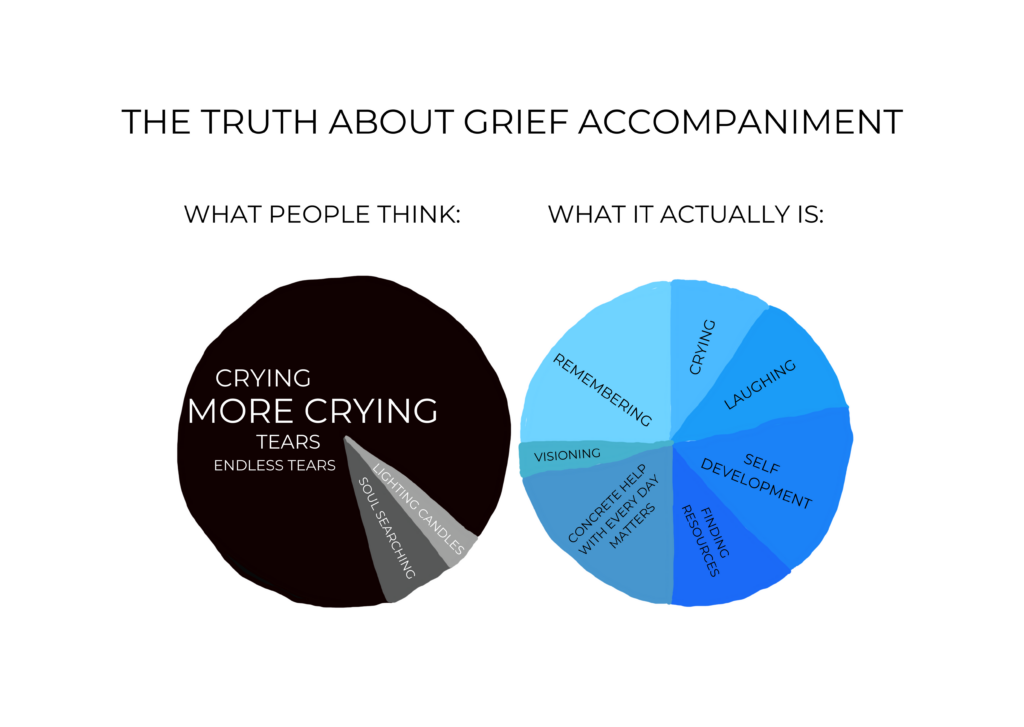
Even though there isn’t a suitable term in English, the German term Trauerbegleitung best translates to mourning accompaniment. It describes the process of accompanying someone through their grief, walking side-by-side through this painful process.
Many traditional grief theories still aim at ‘getting back to normal’ and ‘letting go’ of the deceased. Sadly, these grief theories are based on the myths that still exist in people’s minds: you shouldn’t feel bad (for too long), grieve alone, stay strong for others, keep busy, and time will do the healing.
Key elements: time, words, closeness & support
Grief requires time, words, closeness, and support. Mourning accompaniment provides a safe space for the bereaved to reflect, to let themselves be carried and supported. Within this space, inner strength will grow to find and create a new purpose in life.
Time
Once you decide to do grief work, you learn to give yourself time. Even while your friends and family members have returned to ‘daily life’, you might still require months or years to deal with your emotions.
Words
In grief accompaniment, we search for words to express the pain. Rituals, images, creativity – and our conversation about those can help find ways to express and deal with the emotions.
Closeness & support
Closeness to others who have experienced similar situations, whether that is in a one-on-one or group situation, can significantly alleviate the sense of being alone. When friends and family members might fail to provide the understanding needed, grief accompaniment will.
Trauma and Grief
Those who do not realize their trauma are forced to repeat or re-enact it.
Pierre Janet
Today we would say that someone who is not able to realise (allowing it to become real) and integrate their trauma is forced to re-live it in the inner and outer world, or it happens to re-enact in their surroundings. The more a person has dealt with their trauma, the more they can release it.
What is traumatic grief?
Traumatic grief is when trauma reactions accompany loss when…
- the loss happens unexpectedly, suddenly, or violently
- the loss happens out of timely order, for example, for parents who lose a child
- the loss occurs to a large population, for example, in terror attacks, plane crashes, during the war, genocide, etc.
Such a loss triggers post-trauma survival mechanisms in addition to mourning of whatever was lost.
How trauma affects grief
People with trauma disorders can often hardly distinguish between the past and the present. The traumatic event was so imprinted on the soul (anatomically, in the brain) that it had to be split off. When triggered, it feels like the event is real in the present.
Signs of unprocessed trauma
If trauma is not integrated into the whole organism, it leads a life of its own; it only comes out like a flashback. Such people usually have disorganised attachments and are suspicious of everything and everyone.
My approach to trauma integration
In trauma integration, sessions focus on gently reconnecting you with your body and emotions so your system no longer has to live in constant survival mode. Drawing on somatic and relational approaches, we move at a pace that feels safe, tracking the nervous system, working with sensations, images and meaning, and always returning to the present moment. Instead of re‑traumatising exposure, the aim is to expand your capacity to feel, relate, and make choices, so past experiences can become part of your story rather than something that takes over your life.
My Work with You
In my work with clients, I follow a different approach: Helping you navigate your life after the loss by dealing with the pain of the loss and, at the same time, creating an inner relationship with the person who is no longer alive.
This is done using a systemic approach: A systemic view doesn’t just take into account the individual bereaved person but the social support system surrounding him or her.
We will work process-oriented: We emphasise or focus on processes, systems, or procedures rather than results.
Grief work is creative relationship work with the ultimate aim of
The Aim of Grief Work
- Accepting grief and pain: Instead of trying/pretending to be ok or strong, accept what is, both within yourself, as well as in response to others. Moving from being at grief’s mercy towards actively dealing with grief.
- Relationship with the intense emotions: Working towards seeing the emotions as helpful allies and necessary parts of the healing process.
- Death and finding a way to relate to the no longer physically present person: Coming to acceptance of the reality of death and finding ways to live a healthy, ongoing emotional relationship with the dead person, one that supports integration into life.
How I Will Work

I offer individual counselling sessions and coaching for couples in formats that work for you: face-to-face in Zurich, online sessions, or therapeutic walking sessions.
My background is broad, including different approaches, therapeutic styles, and techniques. I use whatever is most helpful to the situation and the client, keeping a holistic, integrative perspective.
The best way to find out if we can work together and if my style fits your needs is by setting up a time for a discovery session.
Type of Sessions
Online session
I work with you for 60 or 90 minutes, either via Zoom or FaceTime. If you’re unsure about online sessions, feel free to schedule a discovery session and give it a try. You can find out more about online therapy here.
Face-to-face session
For those who are located in the vicinity of Zurich, Switzerland, and prefer a personal meeting, I will meet you in a public place of our mutual agreement. For sessions away from my home office, a ‘travel fee’ will be charged per session, depending on location. There are limited times available for face-to-face sessions in a therapy space in Erlenbach, Zurich.
Benefits of a therapeutic walking session
We will mostly go for a therapeutic walking session. Neuroscience has shown that the lateralized eye movements, which are automatically present in the optic flow, for example, while walking, a naturally calming action, the activity of the amygdala, the limbic system in the brain, which is responsible for threat detection and stress.