
Supporters Resources
If you are supporting someone who is grieving or traumatised, you are in the right place,
and you do not have to figure this out alone. This space offers gentle and practical guidance
to help you show up in ways that are truly supportive, grounded in somatic, relationship-focused
approaches. With small, thoughtful steps, it becomes possible to walk alongside your loved one
so they can feel safer, seen, and less alone in their experience.
If you are the one grieving or traumatised, visit ‘Grieving or Traumatised?’ for more direct help.
How to Support Someone Who Is Grieving
Learn how to support, what to say, and what to avoid when someone you care about is grieving or traumatised.
How you show up matters most when you can stay present, regulate your own nervous system, and offer grounded, relationship‑focused support so your grieving person feels safer, seen, and less alone in what they are going through.
SUPPORT SOMEONE
Quick Start Guide (Choose Your Path):
Key Principles
You are not here to fix.
Your role is to help their nervous system feel safe.
Small consistent presence > big gestures.
Who This Is For
You want to help but don’t know how. This is normal and to be expected if you’ve never experienced what they are experiencing.
You feel with them, yet you feel overwhelmed.
You’re unsure when to reach out, what to say or what not.
This is for you if you are a family member, friend, relative, or professional support person.

“Your role is to help their nervous system feel safe.”
Nathalie Himmelrich
How to Support
Being truly supportive requires being present. To know your own capacities and your limits. To be real about what you can offer and what you can’t.
The person opens up and tells you about their loss or trauma.
✔️ “Thank you for trusting me with this”
❌ “I know exactly what you’re going through”
✔️ “Do you want to talk about it or just be together?”
❌ “You need to move on”
They’re overwhelmed by daily responsibilities (cooking, laundry, appointments, childcare).
✔️ “I’m going to drop off groceries tomorrow. What would be helpful—do you need specific items? I can also handle a load of laundry if you’d like.”
❌ “Just let me know if you need anything!”
✔️ “I’m free Tuesday morning. Would it help if I picked up your kids from school, or would you prefer I handle something else?”
❌ “You need to get back to normal routines—it’s healthy for you.”
The person appears visibly distressed, is crying, or is withdrawn during a visit or conversation.
✔️ “I can see this is hard right now. I’m here—do you want to talk, or should we just sit together?”
❌ “Don’t cry, you’ll feel better soon”
✔️ “There’s no timeline for this. You can feel, however, you feel around me.”
❌ “You should get out of the house and get some fresh air”
✔️ “It’s okay if you’re not okay.”
❌ “I hate seeing you like this”
You’re reaching out by text/call, or you’re unsure if contact is welcome.
✔️ “I’m thinking of you today. No need to respond—I just wanted you to know you’re on my mind.”
❌ “How are you doing?”
✔️ “I have Saturday afternoon free. Would it help if I came by for a walk, or would you prefer space right now?”
❌ “Let’s do something fun to take your mind off things”
✔️ “I’m sorry, and I’m here. You don’t owe me explanations or updates.”
❌ “Everything happens for a reason”
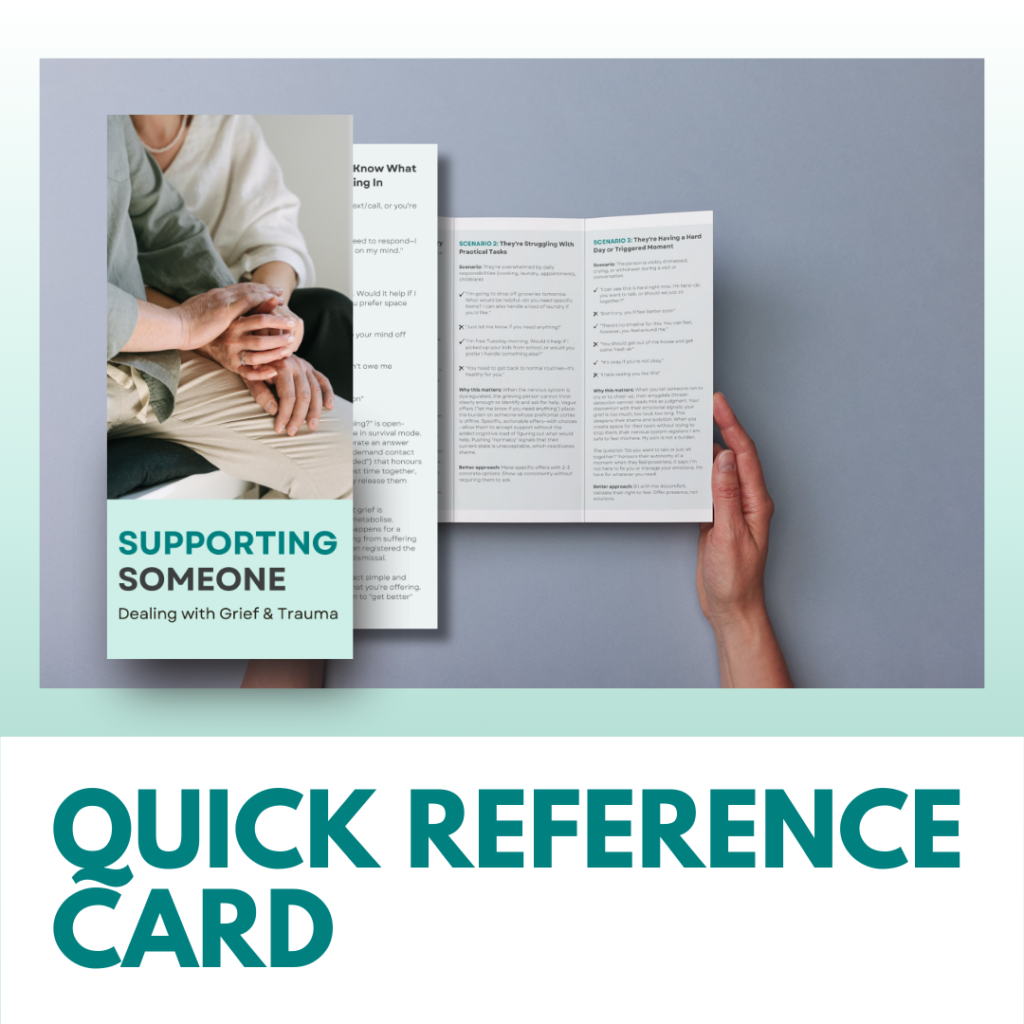
Supporting someone dealing with grief & trauma Reference Card
This free printable leaflet, which you can carry with you, gives you a science-based somatic background to understand the scenarios mentioned above.
This guide helps you know what to say, what to avoid, and how to support a grieving loved one using somatic and relationship‑focused tools.
Download the grief & trauma supporter Quick Reference Card (PDF) now!
General Resources
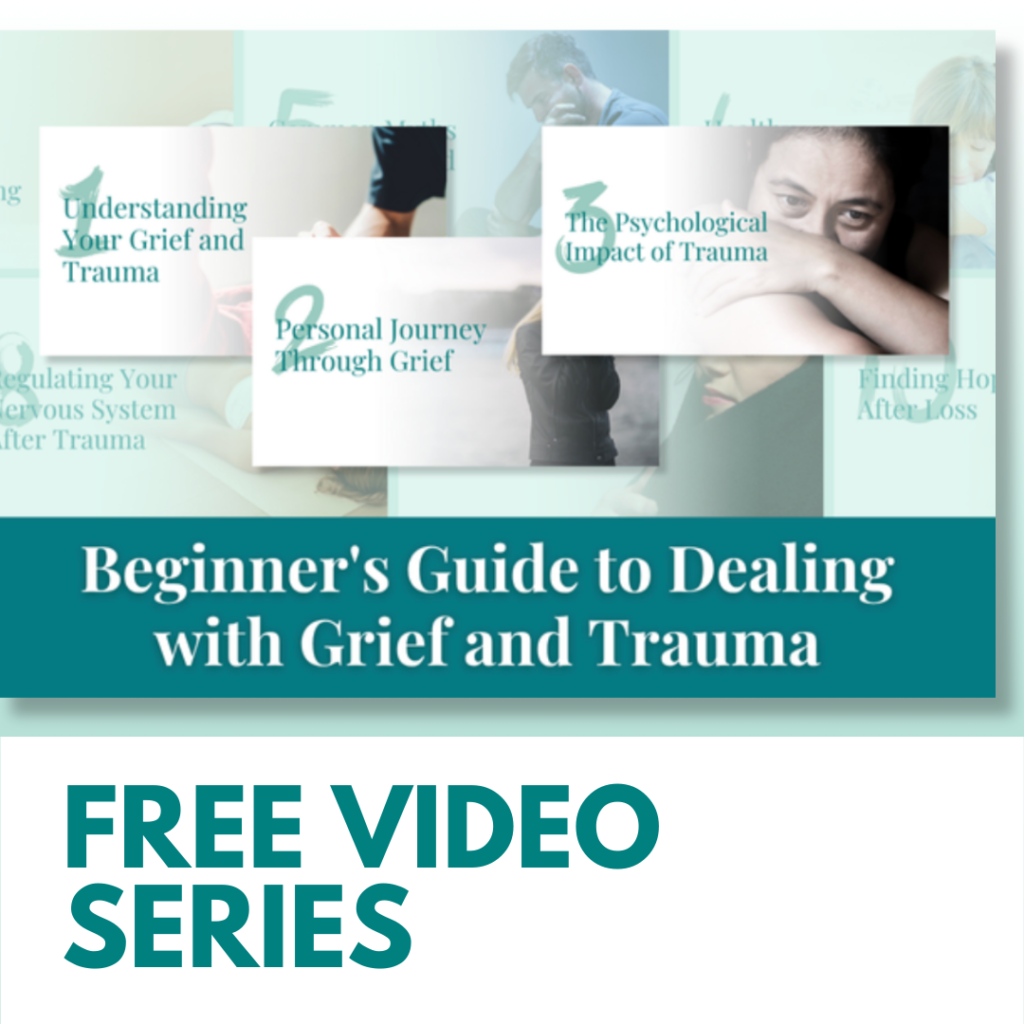
- Start here: Beginner’s Guide to Dealing with Grief and Trauma, free video series by Nathalie Himmelrich
- Circles of Support, article by Nathalie Himmelrich
- The Loneliness of Loss & What to Say (and What Not to Say), podcast episode by Nathalie Himmelrich
- Purchase Bridging the Grief Gap, by Nathalie Himmelrich, 2021
- If you are supporting bereaved parents, check out chapter 12 in Grieving Parents: Surviving Loss as a Couple, by Nathalie Himmelrich, 2014
- The Complete List Of Do’s And Don’ts When Supporting The Bereaved, article by Nathalie Himmelrich
Watch the free Beginner’s Guide video series now!
What to Say or Not Say
Many supporters, as well as the bereaved or traumatised, experience great distress and are overwhelmed by the situation.
In most cases, even if your comments are well-intentioned, they can be harmful and cause further stress.
Remember that even if something is cognitively true, it might be emotionally barren and useless, such as “at least you have another child and she is healthy” when the other twin has just died.
“You are not here to fix them.”
Nathalie Himmelrich
What to Avoid
Even with the best intentions, some common responses can unintentionally hurt. Here’s why and what happens in the brain when we avoid these:
❌ Unsolicited advice
Example: “You should just go out and have fun.”
Why this matters:
- When someone is grieving or traumatised, their prefrontal cortex (the rational decision-making part of their brain) is offline, and their nervous system is in survival mode.
- Advice, even well-meaning, activates their threat-detection system because it signals judgment: you’re doing grief wrong.
- This triggers shame and defensive responses, making them feel more isolated, not less.
✔️ Better approach: Ask permission before offering perspective: “Would it be helpful if I shared something?”
❌ Suggestions on how to “get better”
Example: “You need to move on,” “You should try yoga/meditation/exercise.”
Why this matters:
- Trauma and grief dysregulate the nervous system.
- While movement and mindfulness help eventually, suggesting them too early communicates: your pain is inconvenient to me; I want you fixed.
- Their body is in hypervigilance or shutdown mode; they cannot simply “think positive” their way out.
- Pushing healing timelines can retraumatise by dismissing the validity of their current state.
✔️ Better approach: “I’m here for however long you need. What would feel most supportive right now?”
❌ Pity
Example: “You poor thing, I cannot imagine going through what you are.”
Why this matters:
- Pity creates a power imbalance. It positions the griever as broken, pitiful, less-than, reinforcing shame and unworthiness that trauma often activates in the nervous system (polyvagal shutdown).
- Pity isolates because it’s about how you feel about their suffering, not validation of their strength. Their nervous system reads pity as “you’re fragile” rather than “you’re capable.”
✔️ Better approach: Compassion instead: “Your strength through this is remarkable, and I’m honoured to witness your journey.”
❌ False Understanding
Example: “I completely understand. When my dog died…”
Why this matters:
- Comparing different losses invalidates their specific grief.
- Neurobiologically, the brain encodes each loss uniquely based on the person’s attachment type, life stage, and trauma history. When you equate your pet’s death to their child’s death, their amygdala (emotion centre) detects incongruence and threat, and they experience this as profound dismissal. It signals: your loss isn’t special; get over it as I did.
✔️ Better approach: Hold the difference: “I haven’t experienced what you have, but I can see how profound this is for you. Tell me about them.”
❌ Silver Linings
Example: “At least she didn’t suffer for long,” “At least you have another child.”
Why this matters:
- The grieving brain cannot integrate these statements cognitively when the emotional brain is in distress.
- Even if factually true, neurologically these statements feel invalidating because they bypass the pain—they’re attempts to minimise. In trauma recovery, the nervous system needs acknowledgement of all the pain before it can metabolise anything else.
- Jumping to silver linings tells the person: your grief is wrong; stop feeling.
✔️ Better approach: Stay with the pain: “The suffering was so brief, and it’s still an unbearable loss. I’m so sorry.”
❌ Comparisons to others’ experiences
Example: “The same happened to my friend…”
Why this matters:
When the nervous system is dysregulated by loss or trauma, it cannot generalise or learn from others’ stories. Instead, it’s in freeze, fight, or flight. A comparison, even meant to show “you’re not alone,” can feel like:
- Deflection (shifting focus from their pain to someone else’s)
- Dismissal (their unique loss being categorised with others)
- Threat (subtle message that everyone gets through this, so your struggle is weakness)
Neurobiologically, this prevents the griever from feeling truly seen in their specific pain, which is necessary for nervous system regulation.
✔️ Better approach: Singular focus on them: “This loss is uniquely theirs. What do they need from me right now?”
Why These Matter: A Nervous System Perspective
When someone experiences significant loss or trauma, their nervous system shifts into a survival state. This isn’t weakness; it’s biology.
Understanding what happens neurologically helps you support more effectively:
What happens in the grieving/traumatised brain
- Prefrontal cortex (rational thinking) goes offline → logic and reasoning aren’t available
- Amygdala (threat detection) becomes hyperactive → every comment is scanned for danger/dismissal
- Vagus nerve (nervous system regulator) is dysregulated → they oscillate between hypervigilance and shutdown
- Temporal brain encodes memories differently → the loss feels perpetually fresh

What This Means for Support:
The grieving person isn’t resistant to help. Their nervous system literally can’t access the help you’re offering until they feel safe, seen, and validated. Your role isn’t to fix them. It’s to help their nervous system recognize safety again.
Support Books for Grief and Trauma
Below you find just a few of Nathalie’s favourite support books for supporters of the bereaved and traumatised.
You can find the complete Grief & Trauma Reading List here, listing books in additional categories such as:
- Trauma & Healing – with science-based background knowledge
- Grieving Mother – for mothers who have lost a baby or child
- Loss of Mother – for those who have lost their mother
- Grieving Father – for fathers who have lost a baby or child
- Loss of Father – for those who have lost their father
- Children’s Books – for children dealing with G&T
- Spiritual, Religious, Inspirational
- Memoirs
Click the + symbol to find suggested books in the area you are most interested in.

- Grieving Parents: Surviving Loss as a Couple by Nathalie Himmelrich
- Surviving My First Year of Child Loss: Personal Stories from Grieving Parents by Nathalie Himmelrich
- It’s Ok That You’re Not Ok: Meeting Grief and Loss in a Culture That Doesn’t Understand by Megan Devine
- The Grieving Body: How the Stress of Loss Can Be an Opportunity for Healing – A Psychology Guide to Physical Health and Coping by Mary-Frances O’Connor
- The Grieving Brain: The Surprising Science of How We Learn from Love and Loss by Mary-Frances O’Connor
- The Body Keeps the Score: Brain, Mind, and Body in the Healing of Trauma by Bessel van der Kolk
- The Biology of Trauma: How the Body Holds Fear, Pain, and Overwhelm, and How to Heal It by Aimie Apigian
- Waking the Tiger: Healing Trauma by Peter A. Levine
- Healing Trauma: A Pioneering Program for Restoring the Wisdom of Your Body by Peter A. Levine
- In an Unspoken Voice: How the Body Releases Trauma and Restores Goodness by Peter A. Levine
- Trauma and Memory: Brain and Body in a Search for the Living Past: A Practical Guide for Understanding and Working with Traumatic Memory by Peter A. Levine
- An Autobiography of Trauma: A Healing Journey by Peter A. Levine
- The Brain Partnership Toolbox for Addiction, Mental Health, and Trauma Professionals: Practical Neuroplasticity Tools for Resilience, Regulation and Compassionate Leadership in Trauma-Exposed Work by Kate Truitt
- Healing in Your Hands: Self-Havening Practices to Harness Neuroplasticity, Heal Traumatic Stress, and Build Resilience by Kate Truitt
- Keep Breathing: A Psychologist’s Intimate Journey Through Loss, Trauma, and Rediscovering Life by Kate Truitt
- Healing the Fragmented Selves of Trauma Survivors: Overcoming Internal Self-Alienation by Janina Fisher
- The Myth of Normal: Trauma, Illness, and Healing in a Toxic Culture by Gabor Maté and Daniel Maté
- Healing Collective Trauma: A Process for Integrating Our Intergenerational and Cultural Wounds by Thomas Hübl
- The Polyvagal Theory in Therapy: Engaging the Rhythm of Regulation by Deb Dana
- Polyvagal Exercises for Safety and Connection: 50 Client-Centered Practices by Deb Dana
- Anchored: How to Befriend Your Nervous System Using Polyvagal Theory by Deb Dana
- Polyvagal Practices: Anchoring the Self in Safety by Deb Dana
- Our Polyvagal World: How Safety and Trauma Change Us by Stephen Porges and Seth Porges
- Complex PTSD: From Surviving to Thriving: A Guide and Map for Recovering from Childhood Trauma by Pete Walker
- Healing Developmental Trauma: How Early Trauma Affects Self-Regulation, Self-Image, and the Capacity for Relationship by Lawrence Heller and Aline LaPierre
- Healing Your Grieving Heart for Kids: 100 Practical Ideas, Alan D. Wolfelt
- Lifetimes: The Beautiful Way to Explain Death to Children, Bryan Mellonie and Robert Ingpen
- Tear Soup: A Recipe for Healing After Loss by Chuck DeKlyen and Pat Schwiebert
Links on this page are affiliate links – all proceeds go to the Grieving Parents Support Association (GPSA), donating our resource books for parents in need. Read more about our Affiliate Disclosure here.
Supporter FAQ
These are some of the most common questions supporters ask.
How often should I check in with someone who is grieving or traumatised?

Check in more than once and over a longer period, but keep it light and low‑pressure. You might send a short message every few days at first, then space it out based on their responses and energy. You can say explicitly that they don’t have to reply, which reduces pressure and still signals consistent care.
What can I say when I don’t know what to say?
Name your care and your uncertainty, instead of trying to find the “perfect” words. Simple phrases like “I’m so sorry this is happening”, “I care about you”, or “I’m here, and I’m listening” are often more regulating for their nervous system than advice or solutions. Staying present and curious is more helpful than trying to fix the situation.
What should I avoid saying or doing so I don’t make things worse?

Avoid minimising (“at least…”), comparing their loss to other situations, giving quick advice, or trying to find a positive meaning too soon. These responses can make their nervous system feel unseen and unsafe, even when your intention is kind. Instead, stay with their reality, acknowledge how hard it is, and let them set the pace of the conversation.
How can I help with practical tasks without overstepping or taking over?
Offer specific, concrete help rather than “Let me know if you need anything”, which is often too open‑ended. For example, “I can cook dinner on Tuesday or Thursday, would either help?” or “I’m going to the shops, can I pick up groceries for you this week?” Check in with them about what feels supportive, and be prepared to accept “no” without withdrawing your care.
How do I look after myself while supporting someone through grief or trauma?

Notice your own limits, emotional responses, and energy, and respect them rather than pushing past them. It is healthy to take breaks, seek your own support, and set gentle boundaries around when and how you are available. Looking after your nervous system allows you to stay grounded and present, which is ultimately more supportive for the grieving person. Many supporters, as well as the bereaved or traumatised, experience great distress and are overwhelmed by the situation.