
Trauma doesn’t come in one shape. It doesn’t arrive with a single face, a single story, or a single name. And yet, so many of us quietly wonder whether what we’ve been through is “really” trauma, whether it’s serious enough, clear enough, or dramatic enough to deserve that word.
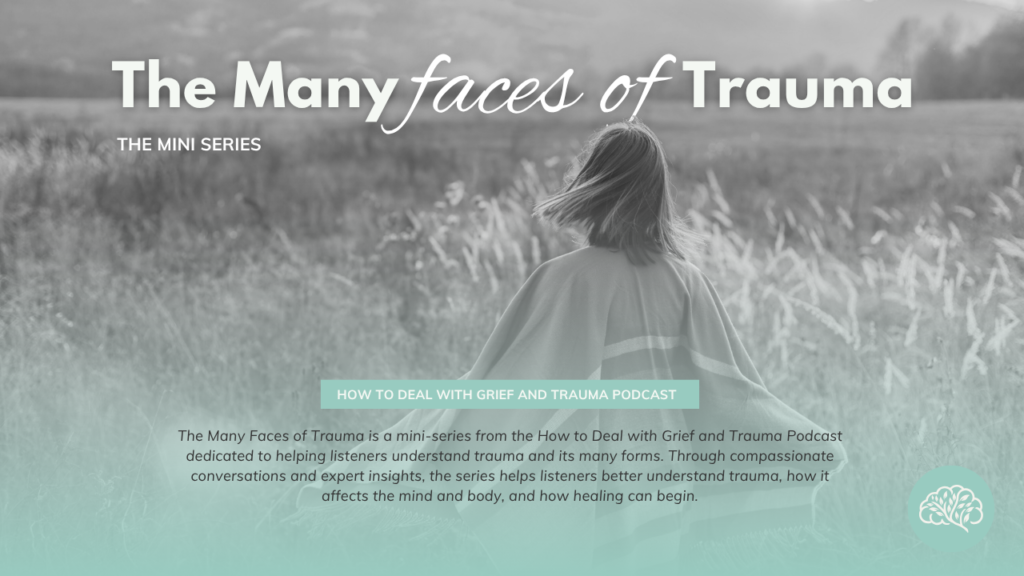
That question is exactly why this series exists.
Starting with Episode 161, Collective Grief and Trauma, the How to Deal with Grief and Trauma podcast launched a new dedicated series called The Many Faces of Trauma, running across Seasons 16 and 17. Over 20 episodes, the series maps the wide and often-overlooked terrain of trauma: what it is, how it takes hold, and why it looks so different from person to person.
Table of Contents
What the series covers
The episodes move across the full spectrum of traumatic experience. Some of the types explored include:
- Collective trauma — what happens when an entire community is shaken at once (E161)
- “Small t” and “big T” trauma — and the important, often-missing middle ground (E164)
- Preverbal trauma — wounds formed before language, stored in the body rather than memory (E165)
- Attachment and relational trauma — not one dramatic event, but patterns over time (E166)
- Developmental trauma — chronic stress during childhood and its lasting shape (E167)
- Intergenerational trauma — what gets passed down through families, often invisibly (E168)
The most-listened-to episode was the one where I spoke about how trauma can affect the body. Listen to it here: 180 The Many Faces of Trauma | How Trauma Can Affect the Body
You can find the full list of episodes on the Podcast Archive page.
Why this matters
One of the most damaging things about trauma is the tendency to minimise it — in ourselves and in others. When we can name what we’re carrying, something shifts. Understanding that trauma can be relational, developmental, collective, or even pre-verbal opens the door to recognising experiences that might otherwise go unacknowledged and unhealed.
This series was built for anyone who has ever thought: I don't know if what I experienced counts. It counts. And this series helps you understand why.
Who this series is for
Whether you are living with the effects of trauma yourself, supporting someone who is, or working professionally in this space, these episodes offer clear, accessible, compassionate explanations. Each episode is short (roughly 14–18 minutes), making it easy to listen in manageable pieces.
Listen and share
You can find the full Many Faces of Trauma series on Spotify, Apple Podcasts, and all major podcast platforms. If this series speaks to something you or someone you know is carrying, please share it. Awareness is one of the first steps toward healing.